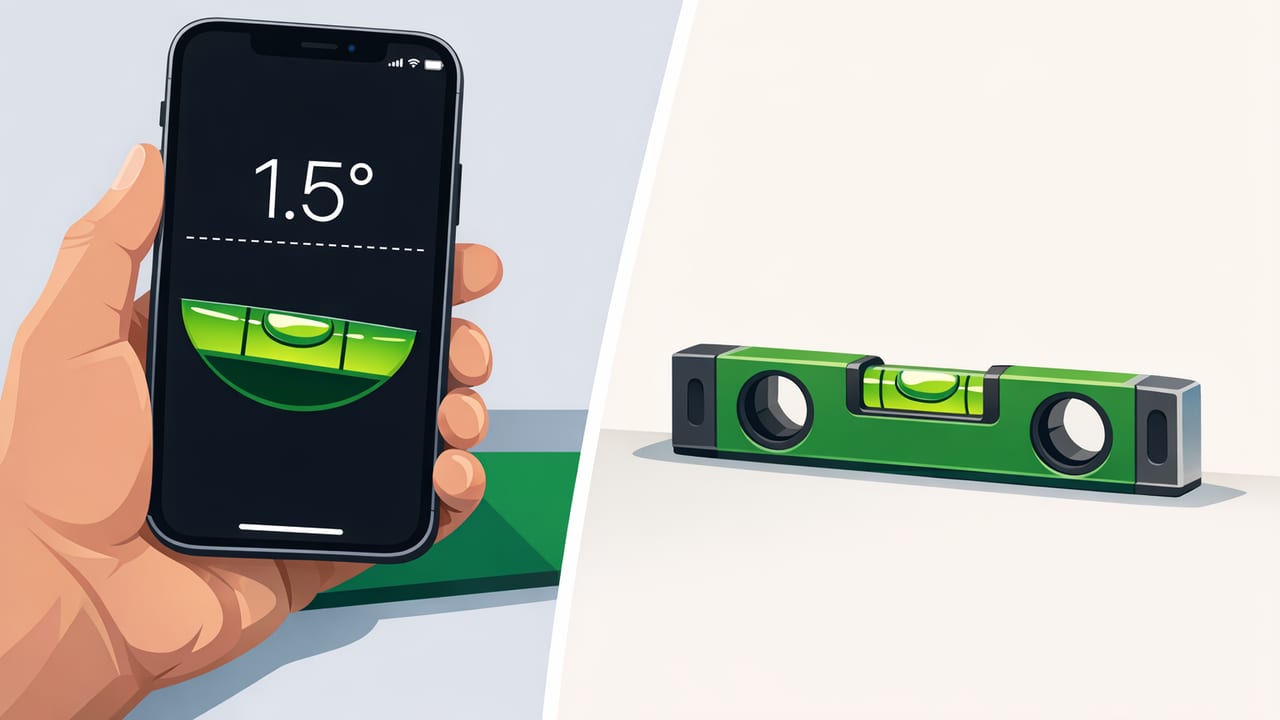
If you’ve ever leveled a shelf, set cabinet bases, or checked whether a patio slab is sloping correctly, you’ve likely asked the same question: is an iPhone level as accurate as a physical spirit level? The short answer is that both can be accurate—in the right conditions. But their accuracy depends on different things, and they fail in different ways.
This guide walks through how each tool works, what “accuracy” really means in the field, and how to decide which one to trust for specific tasks. It’s written to help DIYers and pros make a confident choice when they need level, plumb, or a precise angle.
How an iPhone level works (and what it’s really measuring)
An iPhone level app typically uses the phone’s accelerometer (and often the gyroscope) to estimate orientation relative to gravity. In plain terms, it measures the direction of “down” and calculates the angle of the phone’s body against that gravity vector.
- Level (0°): the phone is perfectly horizontal.
- Plumb (90°): the phone is perfectly vertical.
- Slope/angle: anything in between.
That means an iPhone level does not measure the surface directly—it measures the phone’s orientation while the phone is resting on or aligned with something. If the phone sits flat and doesn’t rock, you can get excellent results. If the phone is tilted by a case lip, camera bump, debris, or an uneven contact point, the reading can be misleading.
How a physical spirit level works
A traditional spirit level uses one or more sealed vials filled with liquid and an air bubble. The vial is mounted at a known angle relative to the level’s body. When the body is level, the bubble centers between two marks.
Physical levels come in many forms:
- Torpedo level: compact, great for tight spots.
- Box/I-beam level: longer spans, better for framing and cabinetry.
- Post level: wraps around posts, checks plumb easily.
- Digital level: combines a sensor with a rigid body, often showing degrees and pitch.
A spirit level measures angle through the vial geometry. Its core advantage is a rigid reference edge designed to contact work surfaces reliably.
Defining accuracy: “close enough” vs precision you can verify
When people compare iPhone level vs physical spirit level, they usually mean one of these:
- Absolute angle accuracy: how close the reading is to true level/plumb (in degrees).
- Repeatability: whether you get the same result every time you measure the same surface.
- Practical build accuracy: whether the result is good enough for the job (tile, trim, framing, machinery, etc.).
In real projects, repeatability is often more valuable than theoretical accuracy—because it helps you make consistent decisions (shim here, plane there, tighten that bracket) without second-guessing.
Quick comparison table: iPhone level vs spirit level
| Factor | iPhone level app | Physical spirit level |
|---|---|---|
| Reference edge quality | Depends on phone flatness, case, camera bump | Purpose-built machined edge (varies by brand/grade) |
| Typical best use | Quick checks, angles, tight access, short spans | Long spans, framing/cabinetry, verifying flatness over distance |
| Calibration | Can be calibrated in-app (must be done correctly) | Factory set; can be checked with flip tests |
| Repeatability | High on stable surfaces; drops if it rocks | High if the level is straight and undamaged |
| Visibility | Great in low light (screen brightness) | Depends on vial visibility; some have LED vials |
| Durability | Phone risk (drops, scratches) | Designed to be knocked around (to a point) |
| Length advantage | Limited (phone size) | Major advantage (24", 48", 72" and beyond) |
Where iPhone levels can be surprisingly accurate
An iPhone level can perform very well when:
- The phone contacts a surface solidly (no rocking).
- The surface is shorter than the phone or you’re checking a localized spot.
- You need an angle (e.g., 2.0° slope for drainage or a miter setup check).
- You’re working in a tight area where a torpedo level won’t fit.
Examples where a phone level often works well:
- Checking if a washing machine is approximately level before final adjustment.
- Confirming a short bracket or small mounting plate is plumb.
- Setting a consistent slope on a short run (like a small drain line section) when you can reference the same contact point each time.
Where physical spirit levels usually win
A spirit level tends to outperform a phone when:
- You need to average over a longer span (walls, studs, joists, long shelves).
- You’re verifying straightness/flatness across distance (a phone can’t bridge dips).
- The surface is rough, dusty, or uneven and would cause the phone to rock.
- You need hands-free positioning (levels can be wedged, clamped, or magnetized).
Real-world cases where a longer spirit level is the safer choice:
- Aligning cabinet runs and ensuring faces stay in plane.
- Framing walls where small errors multiply over height/length.
- Setting door jambs where plumb affects reveals and swing behavior.
The biggest error sources when comparing iPhone level vs spirit level
1) Contact and “rocking” error (phone-specific)
The iPhone’s shape creates unique contact issues:
- Camera bump: can prevent flat seating on a surface.
- Protective cases: thick edges can tilt the phone.
- Small debris: a single screw head or grit can change the angle slightly.
Mitigation: use the flattest side of the phone, remove bulky cases when doing precision work, and ensure a clean contact area.
2) Length and averaging (spirit level advantage)
A long level “averages” bumps and dips. A phone can only tell you the local angle where it sits. If a shelf has a slight bow, a phone reading at the center might look level even if the ends are off.
Mitigation: take multiple readings across the span, or use a longer physical level/straightedge.
3) Calibration drift or baseline error (both tools)
Both tools can be wrong if their zero is wrong:
- A phone app might be uncalibrated (or calibrated on a surface that wasn’t actually level).
- A spirit level can be out of calibration if it’s dropped or the vial shifts (more common in cheaper levels).
How to do a fair accuracy check (simple flip test)
Whether you’re validating a spirit level or an iPhone level app, the key is to test symmetry. Here’s a practical method you can do on-site.
Flip test steps
- Find a reasonably flat surface (countertop, sturdy shelf, machined edge).
- Place the tool (phone or level) and record the reading.
- Rotate the tool 180° on the same spot (end-for-end) and record the reading again.
- Compare the two readings.
Interpretation: if the readings are equal in magnitude but opposite in sign (e.g., +0.2° and -0.2°), your tool is likely centered correctly. If they don’t mirror, there’s an offset.
Tip: Don’t assume the surface is perfectly level. The flip test works even if the surface is slightly off because you’re checking the tool’s internal reference, not the surface.
Choosing the right tool for common tasks
Hanging frames and small fixtures
Either works, but an iPhone level is convenient when you’re already holding the phone and the span is short. For wider frames, a longer spirit level helps prevent “looks level from here” problems caused by wall irregularities.
Cabinets, countertops, and long shelves
Use a physical level (long) to span gaps and detect bows. A phone is useful as a secondary check in corners and tight returns.
Drainage slope and pitch checks
Phones can excel because reading degrees or percent slope is fast. Just make sure the phone seats consistently, and take readings at multiple points along the run.
Framing and structural layout
Physical level wins for long spans and repeatable reference edges. A phone is best as a quick spot-check tool, not the primary reference for layout.
Best practices for more reliable phone leveling
- Remove or swap the case if it creates a lip that changes the contact angle.
- Use a consistent edge (same side of the phone) throughout the job.
- Re-check calibration with a flip test when moving between environments (shop to site) or after a drop.
- Measure twice, in two locations along the span to avoid local-surface bias.
Best practices for more reliable spirit-level readings
- Check the level itself periodically using the flip test (especially if it’s been dropped).
- Keep the reference edge clean (drywall mud, sawdust, grout can throw readings).
- Use the right length: longer is generally more informative for flatness and straightness.
- Don’t press or torque the level against uneven surfaces—light, consistent contact is more repeatable.
Bottom line: which is “better”?
In a strict iPhone level vs physical spirit level comparison, the most dependable tool depends on the job:
- Choose an iPhone level for speed, angles, tight access, and quick verification—especially on short spans with stable contact.
- Choose a physical spirit level for long runs, framing/cabinet precision, and situations where a rigid reference edge matters most.
A practical approach many tradespeople use is to treat the phone as a fast secondary reference and the long spirit level as the primary truth tool for critical alignment.
A gentle note on offline iOS tools
If you prefer doing these checks without connectivity or subscriptions, an offline iOS app like Level Tool can be a handy way to keep a level alongside other measurement utilities in one place.
