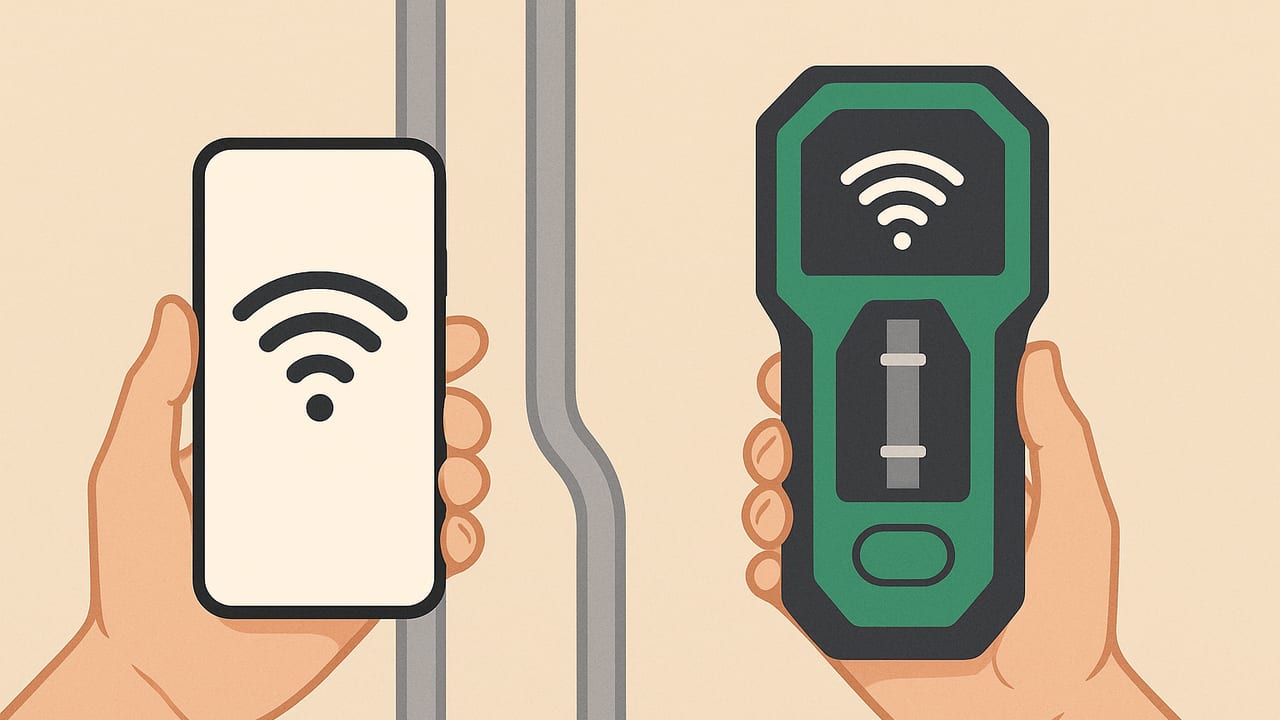
If you are about to drill, mount, or cut into drywall or plaster, your first priority is to detect hidden metal pipes in wall cavities. Striking a water, gas, or heating line can cause expensive damage and safety risks. This guide explains how to use a smartphone and other tools to locate pipes accurately, how to avoid false positives, and when to call in pro-grade solutions.
How Metal Pipes Reveal Themselves Behind a Wall
Hidden infrastructure leaves clues you can measure. Different tools exploit different physics:
- Magnetics: Steel and iron are ferromagnetic and disturb the Earth’s magnetic field. Magnetometers (including those in phones) and simple magnets can detect these disturbances. Note: copper, brass, and aluminum pipes are non-ferromagnetic and won’t register strongly on a phone magnetometer.
- Electromagnetics: Dedicated wall scanners send radio or electromagnetic signals to detect density changes and conductive materials, including non-ferrous metals like copper.
- Thermal: A warm or cold fluid changes pipe temperature. Thermal cameras or IR thermometers can trace the line after running hot or cold water.
- Acoustics: Tapping, listening devices, and tone generators can help track the path of hollow cavities or vibrating pipes.
No single method is perfect. Combining at least two independent methods is the safest approach.
Safety First: Quick Checklist Before You Drill
- Assume there are wires and pipes until proven otherwise.
- Locate studs first; pipes and cables often run parallel or perpendicular near them.
- Use a non-contact voltage tester to screen for live AC near your work area.
- If you plan to open the wall, consider shutting off relevant circuits and water supply to reduce risk.
- Wear eye protection and avoid deep pilot holes; start with shallow, small-diameter holes if verification is needed.
Using Your Phone to Detect Steel Pipes with the Magnetometer
Most modern phones include a 3-axis magnetometer. While it can’t see copper or PEX, it can help you detect hidden steel pipes, iron fittings, or metal studs by measuring magnetic field deviations.
Prepare Your Phone
- Remove thick or magnetic cases, wallets, and metal accessories.
- Enable airplane mode and disable wireless chargers or magnetic mounts to reduce interference.
- Open a trustworthy magnetometer or metal detector app that shows a live microtesla (µT) reading and a graph.
Step-by-Step Sweep
- Baseline: Stand a meter away from the wall. Note the ambient reading (usually around 25–65 µT depending on location).
- Slow Scan: Hold the phone flat against the wall and move horizontally in small increments (5–8 cm). Then scan vertically. Keep the sensor area of the phone (often near the top edge) as consistent as possible.
- Look for Gradients: A steel pipe causes a gentle rise and fall in µT, peaking near the center line. Sharp spikes often indicate screws or nails; broader humps suggest a larger object like a pipe.
- Cross-Confirm: Rotate the phone 90 degrees and scan again. True targets persist across orientations; device-related anomalies don’t.
- Mark Suspects: Use painter’s tape to mark peaks. Repeat the sweep slightly above and below to trace the probable path.
What the Data Looks Like
The following example shows a simple grid log from a horizontal sweep. Readings above baseline signal a likely ferromagnetic object.
position_cm, microtesla
0, 48.2
5, 49.1
10, 51.0
15, 57.6  # rising
20, 63.3  # peak near suspected pipe
25, 58.4
30, 52.0
35, 49.5
40, 48.7
Repeat at multiple heights. If peaks line up vertically, you likely have a vertical run; if peaks align horizontally, the run is horizontal.
Pro tip: Never trust a single pass. Make at least two perpendicular sweeps and verify with a different method before drilling.
Distinguishing Pipes from Studs, Screws, and Wires
- Studs vs. Pipes: Wood studs are not magnetic, but drywall screws in stud lines will create a repeating pattern of narrow spikes every 16 or 24 inches. A pipe’s signal is typically broader and doesn’t repeat at regular intervals.
- Steel Studs: Steel studs produce strong, continuous magnetic anomalies along a vertical line—often wider than a pipe signature.
- Live Wires: A magnetometer won’t confirm live electricity. Use a non-contact voltage tester. If AC is present, stop and reroute your plan.
- Copper Pipes: Don’t rely on phone magnetometers for copper. Confirm copper with a multi-mode stud finder (metal mode), thermal check (run hot water), or a professional tracer.
- Rare-earth Magnet: A small neodymium magnet can physically “stick” through drywall where there’s steel (studs, screws, galvanized pipe), but it won’t stick over copper.
Building Patterns: Where Pipes Tend to Run
Understanding typical routing can reduce guesswork:
- Vertical runs from floors to sinks, showers, and radiators.
- Horizontal runs may occur at common heights (e.g., 12–18 inches above the floor for baseboard heaters or sink feeds at vanity height).
- Within stud bays and through bored holes. Look for protective steel plates near outlet heights, which indicate wires or sometimes pipes.
- Local codes often require protective plates when pipes are close to the drywall surface.
Alternative and Pro-Grade Tools
If you must detect hidden metal pipes in wall materials beyond steel, consider these tools and techniques:
- Multi-mode Stud Finder with Metal and AC: Detects density changes, metal (including copper), and live wires. Good first-line tool.
- Wall Scanners (radar/electromagnetic): Advanced devices distinguish pipe, stud, and wire at greater depths with higher confidence.
- Thermal Camera or IR Thermometer: Run hot water for a few minutes, then scan the wall surface. Warm lines reveal pipe locations, especially for hot-water heating.
- Pipe Tracer/Tone Generator: Pros can connect a transmitter to a metallic pipe and follow the emitted signal with a receiver along the wall path.
- Borescope/Inspection Camera: A tiny hole and scope can visually confirm without a large opening.
- Acoustic Listening: Turn on a faucet; sensitive mics or mechanics’ stethoscopes can help trace vibration paths along studs and surfaces.
Special Wall Types and What Changes
- Plaster and Lath: Metal lath or old nails create widespread magnetic noise. Use a thermal or pro-grade scanner to cut through clutter.
- Tiled Bathrooms: Ceramic and cement board can hide everything. Thermal and pro scanners shine here; magnetometer-only methods are limited.
- Foil-backed Insulation: Continuous foil can create false metal readings. Look for consistent, wall-wide responses, which indicate foil rather than a localized pipe.
- PEX Plumbing: PEX itself is non-metallic (undetectable magnetically), but steel brackets or crimp rings may show small spikes. Treat with caution and verify by thermal or scanner methods.
Workflow: A Reliable, Repeatable Process
- Map Studs First: Use a stud finder or magnet to locate screw lines. Mark them.
- Phone Magnetometer Sweep: Identify broad magnetic anomalies that could indicate steel pipes or studs.
- Voltage Check: Scan for live AC near target areas.
- Second Modality: Use a multi-mode stud finder (metal mode) or thermal method to confirm, especially for copper.
- Trace the Route: Mark multiple points and connect lines to visualize pipe paths.
- Shallow Pilot: If unavoidable, drill a shallow pilot hole with a stop collar and re-check before going deeper.
Simple Wall Map You Can Reuse
Logging your findings helps you avoid surprises later. Here’s a small JSON template you can copy into a note for each wall:
{
  "room": "Upstairs bath - north wall",
  "baseline_uT": 50.1,
  "suspects": [
    { "type": "vertical_metal", "x_cm": 92, "confidence": 0.7 },
    { "type": "stud", "x_cm": 40.6, "confidence": 0.9 },
    { "type": "stud", "x_cm": 81.3, "confidence": 0.9 }
  ],
  "thermal": [
    { "x_cm": 90, "y_cm": 60, "deltaC": 2.8, "note": "Hot water run" }
  ],
  "ac_voltage": [
    { "x_cm": 55, "y_cm": 30, "live": true }
  ]
}
Update the map after any renovations so future work stays safe.
Troubleshooting False Positives
- Phone magnets and speakers: Many cases and phones have small magnets. Remove cases and keep the phone’s bottom speaker away from the wall during scanning.
- Metal furniture or radiators nearby: Large objects can skew readings. Clear the area or note their presence.
- Inconsistent readings: Recalibrate the compass/magnetometer by moving the phone in a figure-eight pattern away from metal.
- Repeating spike patterns: Likely drywall screws on studs, not a pipe.
- Room wiring: Magnetometers don’t detect AC directly, but noise and field distortions can occur. Always verify with an AC tester.
Method Comparison
| Method | Detects Steel | Detects Copper | Typical Depth | Pros | Cons |
|---|---|---|---|---|---|
| Phone Magnetometer | Yes | No | Shallow to moderate | Convenient, free, offline | False positives, limited on non-ferrous |
| Multi-mode Stud Finder | Yes | Yes | Moderate | AC alert, metal mode | Skill needed to interpret |
| Advanced Wall Scanner | Yes | Yes | Deeper | High confidence | Higher cost |
| Thermal Camera/IR Thermometer | Indirect | Indirect | Surface-level | Great with hot water lines | Needs temperature contrast |
| Pipe Tracer/Tone Generator | Yes | Yes (if conductive path) | Good | Precise path tracing | Usually pro equipment |
| Borescope | Visual confirmation | Visual confirmation | N/A | Definitive | Requires small access hole |
FAQs
Can a phone app detect copper pipes?
Not directly with the magnetometer. Copper is non-ferromagnetic, so the phone won’t register it like it would steel. Instead, use a multi-mode stud finder (metal mode), thermal methods, or a professional tracer.
What if my readings change every time?
Recalibrate away from metal; remove the case; keep orientation consistent; and average multiple passes. Confirm with a second method before acting.
How deep can I detect?
Phone-based magnetometer detection is limited—often effective only within a few centimeters if the object is small. Larger steel items can be noticed deeper. For copper at depth, use a wall scanner.
Is it safe to rely on a single tool?
No. Always verify with at least one other method (AC tester, thermal, wall scanner) before drilling.
Putting It All Together
To reliably detect hidden metal pipes in wall structures, build a layered approach: map studs, sweep magnetically for steel, verify electricity with a non-contact tester, and confirm non-ferrous metal with a scanner or thermal method. Mark findings, document a simple wall map, and when in doubt, choose a less invasive fastening point or open a small inspection hole first.
If you want an iOS app that brings multiple measurement tools into a single, offline package, Level Tool includes a magnetometer-based metal detection view along with a bubble level, ruler, compass, and more—handy for the scanning and layout steps described above.
