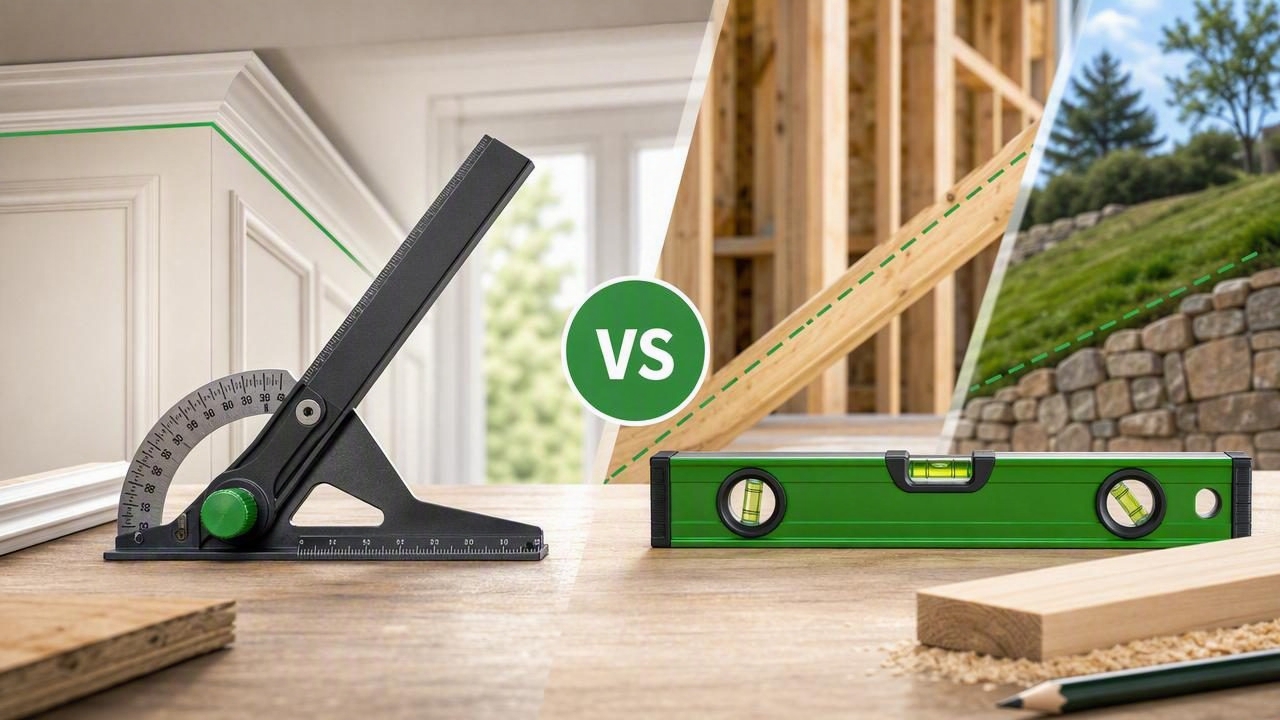
Choosing between a custom angle tool vs carpenter’s level can be confusing because both tools help you build, install, and align with greater accuracy. However, they answer different questions. A carpenter’s level tells you whether something is horizontal, vertical, or plumb. A custom angle tool measures, transfers, or recreates a specific angle.
For many DIY projects, using the right tool at the right stage prevents uneven shelves, poorly fitted trim, inaccurate cuts, and frustrating rework. Understanding the distinction is especially useful when working with sloped surfaces, stairs, cabinetry, framing, furniture, tile, and outdoor structures.
This guide explains how each tool works, where it performs best, when you may need both, and how a phone-based measurement tool can provide a convenient backup for common home improvement tasks.
What Is a Carpenter’s Level?
A carpenter’s level, also called a spirit level or bubble level, is designed to identify whether a surface is level or plumb. Traditional models use a liquid-filled vial and an air bubble. When the bubble rests between marked lines, the tool indicates that the surface is aligned correctly.
Most carpenter’s levels include at least two vials:
- Horizontal vial: Checks whether a surface is level from side to side.
- Vertical vial: Checks whether a wall, post, or object is plumb.
- Angle vial: Some models include a 45-degree vial for common diagonal layouts.
Carpenter’s levels come in many sizes, from compact torpedo levels for tight spaces to 48-inch and 72-inch levels for walls, doors, framing, and long runs of cabinetry. Their main purpose is alignment, not detailed angle measurement.
Best Uses for a Carpenter’s Level
- Installing shelves, cabinets, and wall-mounted televisions
- Checking door frames and window trim for plumb
- Leveling appliances, workbenches, and furniture
- Setting fence posts and deck supports
- Aligning tile, flooring, and backsplash rows
- Checking whether concrete forms or garden borders are level
If your question is, “Is this surface straight and level?” a carpenter’s level is usually the most direct answer.
What Is a Custom Angle Tool?
A custom angle tool is a broad category of tools used to measure, copy, set, or transfer angles. Depending on the design, it may be an adjustable bevel gauge, digital angle finder, protractor, angle locator, sliding T-bevel, or a phone-based inclinometer.
Unlike a standard carpenter’s level, an angle tool gives you a numerical or transferable measurement, such as 22.5 degrees, 37 degrees, or 89.7 degrees. This makes it valuable when an installation, cut, or layout must match an existing angle rather than simply sit level or plumb.
For example, a sloped ceiling may meet a wall at 42 degrees. A carpenter’s level can show that the wall is plumb, but it cannot reliably tell you the exact ceiling angle you need to copy onto trim. A custom angle tool can measure that angle and help you set a saw or mark a cut line.
Common Types of Custom Angle Tools
| Tool Type | What It Does | Typical DIY Use |
|---|---|---|
| Sliding T-bevel | Copies an existing angle without displaying degrees | Transferring trim, molding, and corner angles |
| Digital angle finder | Displays a precise angle digitally | Setting saw blades, checking slopes, measuring roof pitch |
| Protractor or angle gauge | Measures and marks known angles | Crafts, woodworking, layout, and school projects |
| Adjustable bevel gauge | Locks in a selected angle for repeat use | Replicating irregular corners and joinery |
| Inclinometer app | Uses device sensors to show tilt or slope | Quick angle checks, home improvement, and navigation |
Custom Angle Tool vs Carpenter’s Level: Key Differences
The biggest difference is that a carpenter’s level is primarily a reference tool, while a custom angle tool is primarily a measurement and transfer tool.
| Feature | Custom Angle Tool | Carpenter’s Level |
|---|---|---|
| Main purpose | Measure or copy specific angles | Check level and plumb alignment |
| Typical reading | Degrees, slope, pitch, or copied angle | Bubble position or digital level indicator |
| Best for | Trim cuts, stairs, roof slopes, irregular corners | Shelves, posts, cabinets, frames, and appliances |
| Accuracy need | Important for matching cuts and joints | Important for straight, stable installations |
| Can replace the other? | Sometimes for basic leveling, depending on the tool | Usually not for precise angle transfer |
A digital angle finder may include a level mode, and a digital level may display degrees of tilt. Even so, physical tool shape matters. A long carpenter’s level bridges dips, high spots, and small surface irregularities better than a small angle gauge or phone. Conversely, a long level is awkward when you need to duplicate an unusual inside corner for a piece of crown molding.
When a Carpenter’s Level Is the Better Choice
Use a carpenter’s level when the goal is to establish a true horizontal or vertical reference over a meaningful distance. Length is an advantage here. A 48-inch level can reveal a gradual slope across a countertop or shelf that a short tool may miss.
Choose a Level for These Projects
- Hanging cabinets: Start with a level ledger line before mounting upper cabinets.
- Installing a fence: Check every post for plumb before concrete or soil fully sets.
- Setting a washing machine: Confirm the appliance is level to reduce vibration and movement.
- Building a deck: Verify joists, beams, and surface boards follow the intended level plane.
- Mounting shelves: Ensure brackets align horizontally before drilling final holes.
A quality carpenter’s level is also durable, easy to read in bright light, and dependable when batteries are low or a phone is unavailable. For foundational framing, finish carpentry, or professional installation work, it remains a core tool.
When a Custom Angle Tool Is the Better Choice
Use a custom angle tool when “level” is not the target. Many home features are intentionally angled: stair rails, rooflines, ramps, sloped ceilings, drainage paths, decorative trim, and furniture components. In these situations, you need to know the angle or reproduce it accurately.
Choose an Angle Tool for These Projects
- Cutting baseboards around non-square corners: Measure the real corner rather than assuming it is 90 degrees.
- Installing crown molding: Copy ceiling and wall angles before setting compound miter cuts.
- Checking a ramp: Measure slope to confirm it matches your design requirements.
- Setting a miter saw: Use a digital angle reading to verify blade tilt and fence settings.
- Building stairs: Compare repeated stringer and handrail angles for consistency.
- Creating drainage: Check that pavers, shower floors, or outdoor surfaces slope in the intended direction.
Angle tools are especially helpful in older homes, where walls and corners are often slightly out of square. Measuring the actual condition produces a better fit than relying on idealized construction angles.
Do You Need Both Tools for DIY?
For occasional household work, you may not need to purchase every specialized tool immediately. But for regular DIY, woodworking, trim work, or renovation, having both a level and an angle-measuring option is practical.
A simple workflow illustrates why:
- Use a carpenter’s level to make sure the cabinet rail or shelf support is level.
- Use a custom angle tool to measure an adjacent sloped ceiling, wall, or trim intersection.
- Transfer the angle to your material or saw setup.
- Recheck the final installation for level, plumb, and clean alignment.
In short, the level establishes the reference plane. The angle tool handles the exceptions, intersections, and custom cuts that occur around that plane.
How to Get More Accurate Readings
Regardless of which tool you choose, technique affects the result. Follow these practical steps to reduce mistakes:
- Use a clean contact surface: Dust, screws, thick paint, or debris can tilt a tool and distort a reading.
- Check the tool itself: Test a level by taking a reading, rotating it 180 degrees in the same spot, and comparing results.
- Measure twice: Repeat angle readings before cutting expensive trim, tile, or lumber.
- Use a longer level when possible: A longer reference edge gives a more useful picture of an extended surface.
- Calibrate digital tools: Follow the manufacturer’s instructions on a stable, known-level surface.
- Record irregular angles: Label measurements clearly, especially when several corners look similar.
Practical rule: Use a level to make something straight. Use an angle tool to make something fit.
Can an iPhone Work as a Custom Angle Tool?
An iPhone can be useful for quick level, plumb, tilt, and angle checks because its built-in motion sensors detect orientation. A dedicated measurement app can display degrees, help assess slope, and provide a compact reference when you are measuring cabinets, checking furniture, planning a ramp, or evaluating an outdoor grade.
Phone-based tools work best when the device rests flat against a clean, stable surface. Remove a bulky case if it prevents consistent contact, calibrate when the app supports it, and avoid treating a phone as a substitute for a long precision level on critical framing or large-scale construction work.
The advantage is convenience: one offline iOS app can support quick angle checks alongside other useful measurement tasks, such as compass navigation or ruler measurements. For DIY users who want sensor-based tools available without carrying extra gear, Level Tool offers a practical all-in-one option.
Final Verdict: Which Tool Should You Choose?
In the custom angle tool vs carpenter’s level comparison, neither tool wins universally. A carpenter’s level is the better choice for establishing horizontal and vertical alignment. A custom angle tool is the better choice for measuring, transferring, and reproducing angles that are not level or plumb.
Choose a carpenter’s level for shelves, cabinets, posts, doors, and long surfaces. Choose an angle tool for trim, slopes, stairs, rooflines, and non-square corners. For the most reliable DIY results, keep both capabilities available and use each one for the task it was designed to solve.
