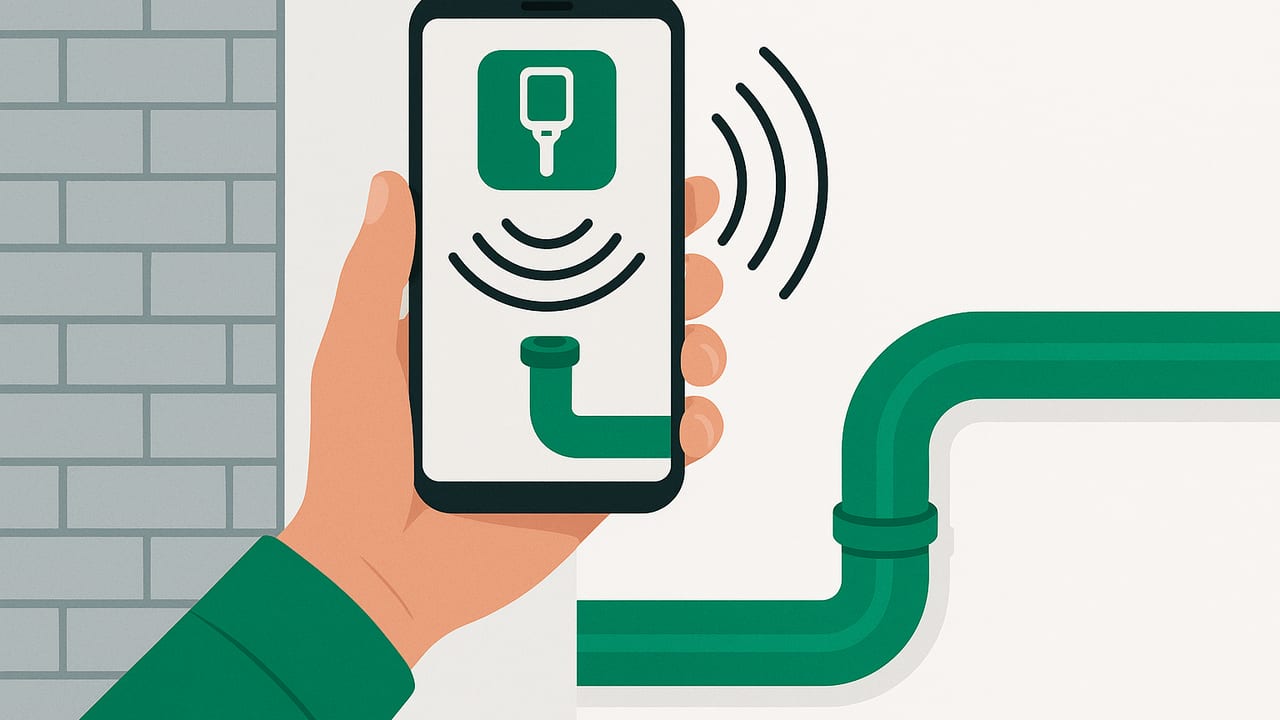
Need to find hidden plumbing before drilling, tiling, or cutting? The idea of using a cell phone metal detector for pipes is appealing because you already carry the device. Modern smartphones include a magnetometer (digital compass) that can sense magnetic fields, and with the right approach you can often locate ferrous plumbing or metal fittings behind drywall, masonry, or under thin flooring. This guide explains how it works, what it can and cannot detect, step-by-step workflows, safety practices, and how it compares with dedicated tools.
How a Smartphone Detects Metal (and When It Doesn’t)
Most phones contain a three-axis magnetometer that measures the strength and direction of magnetic fields in microteslas (µT). Your phone uses it to figure out which way is north, but the same sensor can register a local disturbance in the Earth’s magnetic field caused by nearby ferrous metals (iron, steel). A typical indoor background field is roughly 40–60 µT; a ferrous pipe or steel stud within a few centimeters can add a noticeable bump in that reading.
Key implications:
- Detectable targets: Ferrous metals such as cast iron drain pipes, galvanized steel water lines, black iron gas lines, steel conduit, metal studs, rebar, screws, brackets, and clamps.
- Hard or impossible targets: Non-ferrous metals like copper, brass, and aluminum typically do not produce a strong magnetic signature. PEX tubing itself is plastic and undetectable.
- Workarounds for non-ferrous: Many copper or PEX installations include ferrous brackets, straps, nails, or nearby studs; these are often what the phone finds. Some copper lines also have steel valves or hangers you can detect.
- Depth sensitivity: Most phones only pick up small ferrous objects within about 0–5 cm (0–2 in) through drywall or paneling. Thick plaster, tile, concrete, or multiple layers dramatically reduce sensitivity.
- Interference: Built-in case magnets, MagSafe rings, speakers, and nearby electronics can skew readings. Remove magnetic cases and keep the device flat and steady.
When a Cell Phone Metal Detector Helps vs. When It Won’t
Situations where a phone can be surprisingly useful:
- Locating iron or steel drain stacks in older homes behind drywall.
- Tracing galvanized supply lines vertically from a sink or horizontally across a basement ceiling.
- Confirming metal studs and fastener lines so you can infer safe drilling paths for lightweight anchors.
- Finding brackets and clamps that hold PEX or copper to studs or joists.
Situations where it’s not a good fit:
- Pure copper or PEX runs without ferrous fittings—little to no magnetic signature.
- Deeply buried pipes under concrete or soil—smartphones generally lack the depth penetration.
- Cluttered metal environments (rebar mesh, HVAC ducts) that mask subtle pipe signatures.
Step-by-Step: Using Your Phone to Map a Pipe Behind a Wall
- Prepare the phone. Remove magnetic cases or accessories. Toggle off high-power wireless features if desired to reduce potential interference. Calibrate the compass by slowly moving the phone in a figure-eight motion.
- Open a magnetometer or metal detection app. Look for a live µT readout and a simple graph or audible alert that changes with field strength. The app should let you see relative fluctuations clearly.
- Start with a baseline. Hold the phone flat against a section of wall you believe is clear. Note the baseline magnetic field (for example, 48 µT). Small constant offsets are normal.
- Scan in a grid. Move the phone horizontally in slow, overlapping passes about 2–3 in apart across the area of interest. Then repeat with vertical passes. Maintain a consistent orientation; turning the phone can change readings.
- Watch for peaks. You’re looking for localized increases or decreases in the µT reading that repeat when you pass over the same point. A narrow spike suggests a screw or bracket; a broader ridge that runs vertically or horizontally can indicate a pipe or conduit path.
- Mark the path. Lightly mark the wall where the readings peak. Repeat the scan from an adjacent area to confirm the line. Consistency across multiple passes increases confidence.
- Cross-check. Compare your magnetic map with visual cues: fixture locations (sinks, toilets), typical plumbing runs (vertical up from a fixture, then horizontal), and building logic (shortest path, shared wet walls).
- Validate before drilling. Use a dedicated stud/metal finder or a non-contact voltage tester to ensure you’re not hitting electrical. Drill a small pilot hole in a safe zone if needed, and inspect with a borescope.
Pro tip: For non-ferrous plumbing, scan for fastener lines (screws every 16 in for studs) and brackets first. These hints often outline the pipe’s path even when the pipe itself isn’t magnetic.
Special Cases: Copper, PEX, and Mixed Materials
Copper lines: Copper is non-ferrous, so a phone’s magnetometer won’t directly detect it. However, many copper runs include steel hangers, galvanized straps, or nearby screws. You may detect a dotted line of fasteners; the pipe usually runs a consistent offset from those points. Look for valves or unions (sometimes steel) near fixtures—those are easier to detect.
PEX tubing: PEX is plastic. The only magnetic signatures will come from metal clamps (often stainless, sometimes weakly magnetic), brackets, or mounting screws. Focus your scan where the tubing transitions near manifolds, shutoff valves, or penetrations through studs.
Cast iron drains: These are ideal targets for a phone—large ferrous mass and clear magnetic contrast. Expect a strong, wide signal that tracks vertically through bathrooms and kitchens down to the stack.
Safety and Accuracy Considerations
- Never rely on a single method. A cell phone reading is indicative, not definitive. Confirm with a stud/metal finder, inspection hole, or pro tools if the consequence of a miss is high.
- Mind electrical hazards. A magnetometer doesn’t tell you if a cable is live. Always sweep with a non-contact voltage tester before drilling.
- Call before you dig. For outdoor work, use your local utility locate service (e.g., 811 in many regions). Smartphones are not suitable for locating buried utilities.
- Account for hidden metal. Rebar, corner beads, lath, or metal tile backers can create false positives. Scan a larger area to separate narrow, linear signals from broad background metal.
- Control distance. Keep the phone consistently close to the surface. Even a 1–2 cm change in standoff can alter readings and create false trends.
Smartphone vs. Dedicated Tools
| Tool | Detects | Typical Depth | Strengths | Limitations | Best For |
|---|---|---|---|---|---|
| Phone magnetometer | Ferrous metal (iron, steel) | 0–5 cm | Always with you; quick scan; free/low cost | Limited depth; struggles with copper/PEX; interference | Quick checks behind drywall, finding brackets |
| Stud finder (metal mode) | Ferrous & non-ferrous metal | Up to ~3–5 cm+ | Designed for walls; clear UI | Can misread dense lath or foil insulation | Locating studs, nails, shallow pipes |
| Non-contact voltage tester | Live AC wires | Varies | Fast electrical safety check | Not for pipes; only live circuits | Avoiding live electrical lines |
| Inspection camera (borescope) | Visual confirmation | Line-of-sight | Definitive ID through small hole | Requires access hole | Confirming before critical cuts |
| Pro metal detector | Ferrous & non-ferrous | Greater than phone | Depth and discrimination | Cost; learning curve; indoor clutter | Outdoor locating, large targets |
| Ground-penetrating radar (GPR) | Varied subsurface features | High (material-dependent) | Best for complex or deep scans | Expensive; pro skill | Slab/soil mapping, professional work |
Field Tips to Improve Results
- Remove magnetic accessories. Cases with magnets, wallet attachments, and desk mounts can distort readings.
- Use the phone’s edge. Some devices read more consistently when the magnetometer is closer to the surface; experiment with top, bottom, or side edges.
- Listen and look. Turn on a faucet and listen for water movement in the wall; feel for temperature differences on accessible pipe segments to infer routes.
- Measure from fixtures. Many supply lines rise vertically within a few inches of a faucet centerline, then turn horizontally. Use this logic to predict paths.
- Map, don’t guess. Create a quick pencil grid on painter’s tape; mark consistent peaks; connect the dots to visualize a route.
Optional: Log Magnetometer Data for a DIY Map
If you’re technically inclined, you can log magnetometer data and plot it to clarify peaks. Here’s a minimal Swift example that prints the magnetic field magnitude in µT:
import CoreMotion

let motion = CMMotionManager()
if motion.isMagnetometerAvailable {
    motion.magnetometerUpdateInterval = 0.1  // 10 Hz
    motion.startMagnetometerUpdates(to: OperationQueue.main) { data, error in
        if let f = data?.magneticField {
            let m = sqrt(f.x*f.x + f.y*f.y + f.z*f.z)
            print("µT:", m)
        }
    }
}
Walk your scan grid, export the numbers, and graph them to highlight anomalies. Even a simple spreadsheet chart can make a suspected pipe path stand out.
FAQ
Will a phone detect copper pipes?
Not directly. Copper is non-ferrous and produces minimal magnetic disturbance. However, your phone may find nearby steel fasteners, brackets, or valves along the same route. Treat those as breadcrumbs to infer the pipe’s position.
How deep can a cell phone metal detector for pipes reach?
Expect only a few centimeters through drywall or thin paneling, less through dense plaster or tile. For anything deeper or under concrete/soil, use dedicated sensors or professional services.
Are readings accurate enough to drill by?
Use them as guidance, not permission. Always confirm with a stud/metal scanner and a non-contact voltage tester. If the risk is high, open a small inspection hole and verify with a borescope.
Do cases and MagSafe rings affect results?
Yes. Magnetic accessories can wildly skew the baseline. Remove them before scanning and recalibrate the compass with a slow figure-eight motion.
Can a phone distinguish between a pipe and a stud?
Not by material type alone. A phone registers magnetic field changes, which both steel studs and ferrous pipes produce. Pattern, width, and context (near a fixture vs. on a 16 in spacing) help you tell them apart.
Bottom Line
A cell phone metal detector for pipes is a practical first look for shallow, ferrous-related targets and for finding the fittings and fasteners that often reveal non-ferrous plumbing routes. Respect its limitations—especially with copper/PEX and depth—and always cross-check with purpose-built tools before you cut or drill. If you want an iOS app that works fully offline and includes a metal detector alongside other measurement tools, consider Level Tool as a compact addition to your DIY toolkit.
