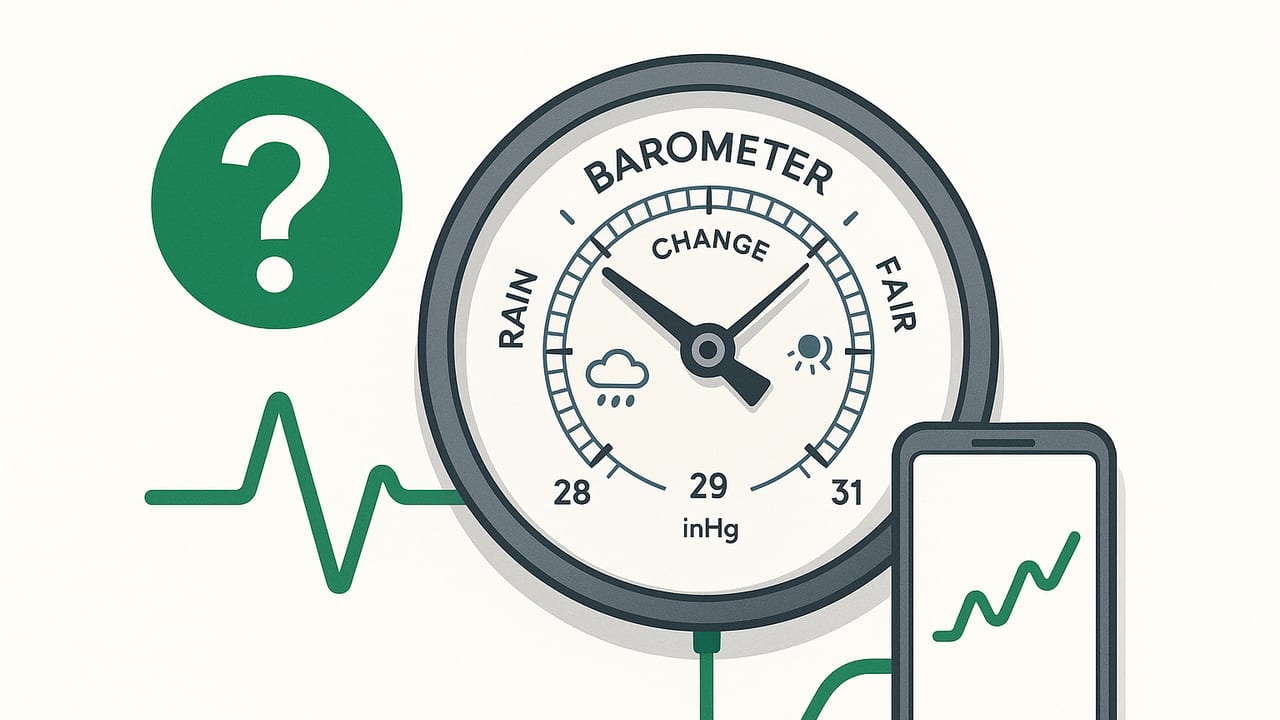
A barometer measures atmospheric pressure—one of the most useful environmental signals you can capture. Whether you want better weather awareness, relative altitude without GPS, or insights for hiking, HVAC diagnostics, or indoor navigation, understanding barometric pressure unlocks practical benefits. This guide explains how a barometer works, which units to use, how to calibrate your sensor, and proven workflows for real-world tasks, including using a smartphone barometer.
How a Barometer Works
Modern barometers use tiny microelectromechanical systems (MEMS) to sense the force exerted by the atmosphere. Inside the sensor, a flexible diaphragm deflects as air pressure changes. This deflection alters an electrical signal, which is digitized by the device. Unlike legacy mercury barometers, MEMS barometers are compact, energy efficient, and accurate enough for both weather and elevation tasks.
- Absolute vs. gauge pressure: Barometers measure absolute pressure relative to a vacuum, not relative to local ambient conditions (gauge). This is why you can compute changes in altitude from pressure alone.
- Typical ranges: At sea level, pressure usually falls between 980–1030 hPa (hectopascals). High-altitude locations read lower values because pressure decreases with elevation.
- Dynamic effects: Wind, motion, and airflow across a microphone or sensor port can temporarily alter readings. For stable results, keep the device still and shielded from gusts.
Barometric Pressure Units and Conversions
Weather reports and instruments display pressure in different units. The most common are hectopascals (hPa), millibars (mbar), inches of mercury (inHg), and millimeters of mercury (mmHg). Hectopascal is the SI-preferred unit; 1 hPa equals 1 mbar.
| Unit | Symbol | Conversion to hPa | Notes |
|---|---|---|---|
| Hectopascal | hPa | 1 | Standard meteorological unit |
| Millibar | mbar | 1 | Numerically identical to hPa |
| Inches of Mercury | inHg | 1 inHg ≈ 33.8639 hPa | Common in aviation and US weather |
| Millimeters of Mercury | mmHg | 1 mmHg ≈ 1.33322 hPa | Used in some scientific contexts |
| Pascal | Pa | 1 Pa = 0.01 hPa | SI base unit; often too granular |
| Kilopascal | kPa | 1 kPa = 10 hPa | Engineering contexts |
Standard sea-level pressure (SLP) is defined as 1013.25 hPa (29.92 inHg). Compare your reading to this baseline to quickly gauge whether conditions are relatively high or low.
Reading a Barometer for Weather
Absolute pressure matters, but trend matters more. Stable or rising pressure usually means fair weather; rapidly falling pressure often precedes storms. The context of your location, season, and frontal boundaries matters, but these rules of thumb are reliable:
- Slow rise (≥0.5 hPa over 3 hours): Improving conditions, clearing skies.
- Steady: Persistence—expect current conditions to continue.
- Moderate fall (1–2 hPa over 3 hours): Unsettled conditions likely.
- Rapid fall (≥3 hPa over 3 hours): Strong fronts or storms possible.
The trend is your friend: focus on the rate of change, not just the number.
To avoid false signals, measure in a space with stable temperature and minimal drafts. Opening a door, moving between floors, or placing your phone near an HVAC vent shifts readings. If you need outdoor-relevant data, place the device near an open window or a sheltered exterior area and allow a minute or two for stabilization.
Altitude from a Barometer
Because pressure decreases with height, you can estimate altitude. Under the International Standard Atmosphere (ISA), the approximate relationship near sea level is:
- Rule of thumb: 1 hPa ≈ 8.3 meters of altitude change (about 27 feet).
- Small changes: A 0.12 hPa drop corresponds to roughly a 1-meter rise.
For better accuracy, use the hypsometric equation. If you know the sea-level pressure (QNH) from a nearby station or the pressure at a reference elevation, you can compute altitude or relative height differences.
Hypsometric Equation (Simplified)
Assuming a standard temperature profile and dry air, altitude z can be estimated from pressure P relative to sea-level pressure P0:
z ≈ 44330 × (1 - (P / P0)^(1/5.255)) // z in meters, P and P0 in hPaFor relative changes over short vertical distances, you can just compare P1 and P2 using the same formula; temperature cancels more cleanly in small intervals.
Code Example: Python
def altitude_from_pressure(P_hpa, P0_hpa=1013.25):
    # Hypsometric approximation (ISA)
    return 44330.0 * (1.0 - (P_hpa / P0_hpa) ** (1.0 / 5.255))

# Example: pressure at your device is 987 hPa, SLP is 1010 hPa
z = altitude_from_pressure(987.0, 1010.0)
print(f"Altitude ≈ {z:.1f} m")
Code Example: Swift
func altitudeFromPressure(_ P: Double, seaLevel P0: Double = 1013.25) -> Double {
    return 44330.0 * (1.0 - pow(P / P0, 1.0 / 5.255))
}

let z = altitudeFromPressure(987.0, seaLevel: 1010.0)
print(String(format: "Altitude ≈ %.1f m", z))
Two calibration strategies are common:
- Known elevation: If you know your current altitude, adjust P0 until the equation returns that height, then track relative changes from there.
- Known sea-level pressure: If a nearby station reports QNH (sea-level pressure), set P0 to that value and let the formula compute your altitude.
Calibrating a Barometer
Calibration removes bias and aligns readings with reference values. A simple calibration is usually enough for consumer-grade sensors:
- Stabilize: Let the device rest for 1–2 minutes away from vents, direct sunlight, and body heat.
- Choose a reference: Use a trusted weather station’s sea-level pressure (QNH) or a known elevation from a survey marker or map.
- Set offset: Adjust the app’s barometer offset so your reading matches the reference. Recheck after significant temperature changes or if you change cases/covers.
Many sensors exhibit small temperature coefficients. If you move from cold outdoors to a warm room, expect a brief drift while the sensor equilibrates. Periodic recalibration—especially when accuracy matters for altitude logs—keeps results tight.
Practical Barometer Uses
- Weather awareness: Track trends throughout the day; a falling barometer can warn of incoming fronts before clouds build.
- Hiking and trail profiles: Log pressure and convert to altitude to estimate elevation gain without waiting for GPS lock in canyons or forests.
- Indoor floor detection: Ascending one floor typically changes pressure by about 0.36–0.40 hPa; this can detect floor transitions in buildings.
- HVAC diagnostics: Identify drafts or pressure imbalances by watching for step changes when systems switch on/off.
- Aviation training (non-certified): Understand QNH/QFE concepts and pressure altitude in a learning context—never for primary navigation.
- Storm doors and sealed rooms: Observe how opening/closing affects indoor pressure to assess sealing effectiveness.
Accuracy, Limitations, and Best Practices
- Resolution vs. accuracy: Many phone barometers resolve to 0.1 hPa (≈0.8 m), but absolute accuracy may be ±0.5–1.5 hPa depending on calibration and temperature.
- Dynamic pressure: Moving quickly, cycling, or holding a device in wind can lower measured pressure. Shield the sensor and pause before recording.
- Temperature effects: Sudden device temperature changes can bias readings. Allow time for stabilization when moving between environments.
- Vent paths and cases: Thick or sealed cases slow the sensor’s response and can create lags. If possible, use cases with pressure vents.
- Smoothing: Apply a short moving average (e.g., 5–10 seconds) for cleaner trends without hiding meaningful changes.
- Compare with references: Cross-check with a nearby weather station. If your reading is consistently high or low, set an offset.
Remember, pressure reflects both weather and altitude. If pressure falls while you climb, the change you see is a combination of both. For clean weather trends, measure at a fixed height. For altitude work, re-zero frequently or keep a constant pace to minimize confounding weather drift.
Example Workflow on a Smartphone Barometer
Weather Tracking
- Pick a location: Place the phone on a stable interior shelf away from vents and sunlight.
- Calibrate: Set sea-level pressure from a reliable nearby source.
- Log regularly: Record pressure every 10–30 minutes. Use a 10-second moving average.
- Interpret: Look for a rise or fall over 3–6 hours. Use the trend to anticipate changes.
Relative Altitude (Stairs or Hills)
- Zero at base: With the device still, record the pressure at your start point.
- Climb steadily: Avoid waving the device in moving air; keep it close to your body but not in a pocket that seals vents.
- Compute gain: Use 1 hPa ≈ 8.3 m, or apply the hypsometric equation to convert pressure differences into elevation gain.
- Validate: If you pass a known elevation sign, recalibrate and keep logging.
Frequently Asked Questions
Do all smartphones include a barometer?
No. Many mid- to high-end devices include one, especially models focused on fitness or navigation. Check your device specifications or a sensor app.
Is a barometer better than GPS for altitude?
For short-term relative changes, yes—barometric altitude is smoother and more responsive. For absolute altitude without calibration, GPS is often better. The best results come from combining both: GPS for baseline, barometer for fine changes.
Why does indoor pressure differ from outdoor?
Buildings can be slightly pressurized or depressurized by HVAC systems and wind. The difference is usually small but noticeable during system cycles or door openings.
How often should I calibrate?
Whenever conditions change notably: moving to a new region, large temperature swings, case changes, or when absolute accuracy matters (e.g., mapping a trail).
Can I use a barometer to predict storms?
Yes—rapidly falling pressure is a classic warning. Combine pressure trends with local forecasts and sky observations for the best results.
What is QNH vs. QFE?
QNH is sea-level pressure; when set, your altimeter shows altitude above mean sea level. QFE is field pressure; set it to read height above a specific reference point (e.g., an airfield). For general use, QNH is more common.
Quick Reference: Rules of Thumb
- Standard sea-level pressure: 1013.25 hPa (29.92 inHg).
- 1 hPa ≈ 8.3 m (27 ft) of altitude change.
- 0.1 inHg ≈ 3.386 hPa ≈ 28 m (92 ft).
- Rapid fall (≥3 hPa in 3 hours) often precedes storms.
- Stabilize the device 1–2 minutes for the most reliable readings.
If you’re getting started, begin by logging pressure twice daily and noting weather changes. Within a week you’ll see how your local patterns behave—sea breezes, frontal passages, and diurnal cycles all leave signatures in the barometer’s trace.
For iOS users who want an accurate, offline barometer alongside other measurement tools like a bubble level, compass, and ruler, the Level Tool app provides a clean workflow and uses on-device sensors without subscriptions.
